
What thoughtful assessment design looks like in the PSLE
Find out more information below.
Last updated on 28 June 2026
At the Committee of Supply Debate in March 2026, Minister for Education, Mr Desmond Lee, drew on a 2022 PSLE Mathematics question to illustrate how SEAB carefully calibrates examination demand, ensuring that challenging questions are structured to provide accessibility to students. The sharing offered a timely reminder of the purpose behind assessment design.
Here is another illustration of SEAB's approach to assessment design. Taken from the 2025 PSLE Science paper, this is an open-ended question that asked students to describe how they would find the volume of an object that floats in water, using a given set of apparatus. By design, the question invited multiple valid approaches rather than a single correct answer.
.png)
Note: National examination questions are copyrighted by the Singapore Examinations and Assessment Board (SEAB) and cannot be reproduced or distributed without proper authorisation.
Most students described submerging the floating object with the help of a 20g mass before applying the standard water displacement method to find its volume. This is a sound and well-reasoned approach. However, there were students who arrived at the answer through other creative methods were equally credited, provided they demonstrated clear scientific reasoning and a correct understanding of the underlying concepts. Take a look at the examples below.
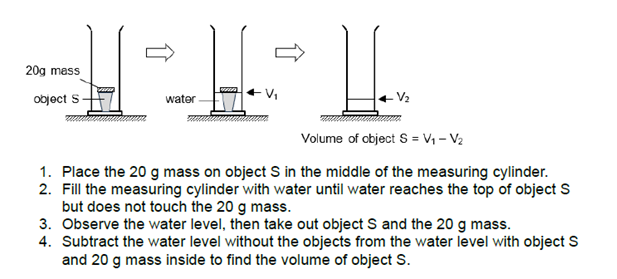
Alternative Response 1
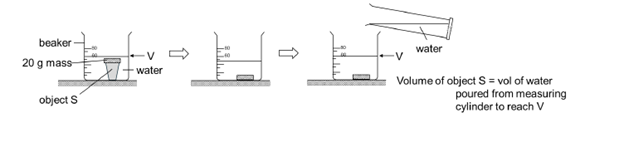
Alternative response 2
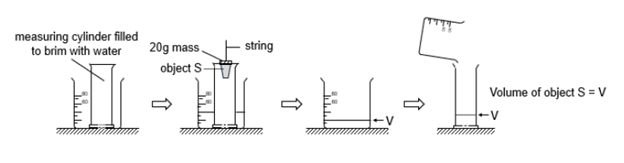
Alternative response 3
Other creative solutions given by our students in response to the PSLE question
The range of responses is a testament to the curiosity and inventiveness that our students have shown from their learning. In the PSLE, marks are awarded for evidence of correct understanding and the application of relevant concepts and skills — and this question showed that there is genuine room for creative thinking within that framework.
Designing assessments for high-stakes examinations requires a careful balance of rigour, fairness, and thoughtfulness — so that the examination system continues to support meaningful learning and remains one that students, parents, and educators can trust.
This is what thoughtful assessment design looks like in practice: setting questions that are rigorous and fair, while leaving space for students to demonstrate their understanding in more ways than one.

Thoughtful assessment design encourages discussion and gives students multiple ways to demonstrate what they know (AI-generated image)