SEAB’s adaptive assessment tools
Find out more information below.
Last updated on 28 June 2026
A teacher marking a Mathematics test may notice that half the class is struggling with fractions but is unsure of where the specific challenges lie. Did some students grasp the basic concepts but fall short of the more difficult ones? Are others missing a more fundamental gap that has been quietly holding them back? Adaptive tests can help answer these questions. By adjusting the item difficulty in real time based on each student's responses, they zero in on exactly where the learner is at. Adaptive tests provide a more personalised assessment experience, letting the learner lead the way while also surfacing precise and actionable insights which help teachers intervene earlier and more effectively, rather than waiting for the next test to find out.
SEAB currently provides a suite of adaptive formative assessments for Primary English Comprehension and Mathematics.
MathsCheckPlus and CATalytics
.png)
Teachers gain better insights into every learner's needs and strengths in Mathematics with SEAB's adaptive tools (AI-generated image)
MathsCheckPlus is a grade-level Mathematics assessment with wide coverage of topics from the Singapore Mathematics curriculum. It is designed to give teachers a clear picture of where their students stand at the end of the year, so that they can plan targeted remediation before they move on to the next level.
MathsCheckPlus is available at both Primary 2 and Primary 4, with the Primary 4 assessment being a multi-stage adaptive test. It is administered online and comprises a diverse range of item types. In the 2025 cycle, over 43,000 Primary 2 and 4 students from 125 schools participated (representing approximately 69% of Singapore’s primary schools). The assessment reports at class- and school-level are provided before the school year begins, allowing teachers to identify and address gaps in students' understanding before they progress to Primary 3 and 5 respectively.
Complementing MathsCheckPlus is CATalytics, a topical adaptive assessment designed to work hand-in-hand with MathsCheckPlus. Where MathsCheckPlus identifies students who may need support in specific areas, CATalytics enables teachers to take a deeper look at students' readiness in those areas. CATalytics helps teachers understand where conceptual gaps lie, enabling them to plan more targeted and effective intervention. We encourage schools to use both tools in tandem to get a fuller picture of each student's mathematical readiness.
This year, approximately 15,000 CATalytics assessments were administered across the topics of Fractions and Measurement, Area & Volume — two areas that are foundational to the upper primary Mathematics curriculum and commonly identified as areas where students benefit from early, focused support.
Read2LearnEL

Going beyond scores to reveal each learner's abilities in English reading comprehension. (AI-generated image)
Read2LearnEL is SEAB's newest adaptive assessment, officially launched in January 2026. Read2LearnEL goes beyond scores and surfaces meaningful insights about where each student stands in reading comprehension with regard to curriculum expectations.
In the most recent administration, approximately 16,000 Primary 5 students across 78 schools participated — a strong uptake built on two years of successful piloting, during which more than 80% of teachers reported that the assessment reports provided rich data that helped them better understand their students' strengths and areas needing extra focus.
Assessment data is delivered through interactive Excel dashboard reports that are intuitive for teachers to navigate. Graphs and heatmaps help teachers spot patterns across classes, while slicers allow for filtering and drilling down into specific comprehension skills or student groups — making diagnostic information easy to interpret and ready to inform instructional decisions.
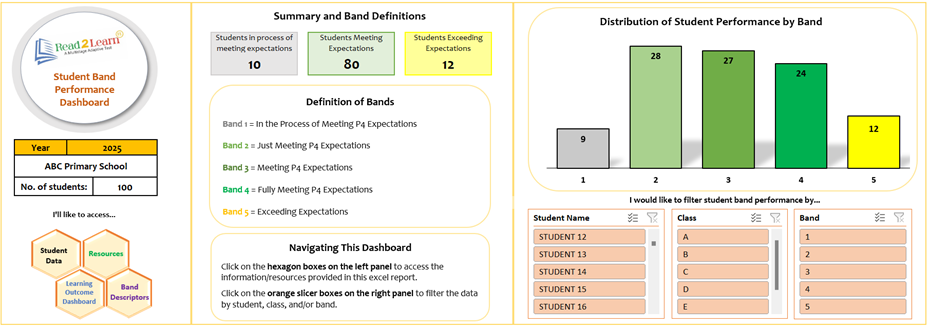
An example of the Read2Learn student band performance dashboard
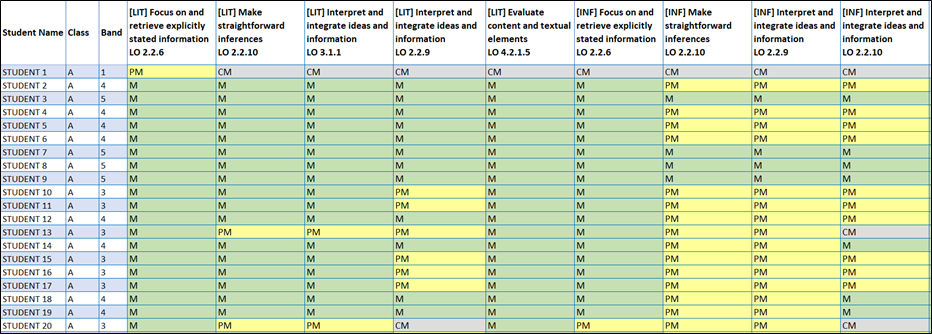
An example of the Excel data available from the dashboard
To support teachers in making the most of this data, SEAB has partnered Master Teachers from the English Language Institute of Singapore (ELIS) since 2024 to establish the Read2LearnEL Networked Learning Community (NLC). The NLC currently has 180 members and brings teachers together three times each year to collaboratively interpret assessment data, distil diagnostic insights, and plan targeted instructional practices. In 2026, we have taken this further by piloting cluster-based NLCs with the N2, N3, and N4 clusters, integrating the NLC's work with existing school-based Communities of Practice (CoPs). This shift towards a more peer-led model is intentional — building collective capacity and fostering a shared ownership of professional growth, where teachers drive data interpretation and instructional planning together within their own professional communities.
Suggested Reads
Click on the card or link below.